
For decades, the most effective way to make fabric shed water was to coat it with fluorinated chemistry, the PFAS family of “forever chemicals”. That era is ending. Regulators in Europe and the United States are restricting PFAS in clothing and textiles, and buyers increasingly ask for fluorine-free finishes as standard.
So how does a PFAS-free water repellent actually work, and what can you realistically expect from one? This guide explains the science in plain terms, and what it means for mills, finishers and anyone protecting upholstery, apparel or outdoor fabric.
Key takeaways
- Water repellency comes from two things: low surface energy and microscopic surface texture.
- Fluorine-free finishes, including nanoscale silica, deliver strong water repellency without PFAS.
- Fluorinated finishes still resist oils better, so match the finish to the stains the fabric will face.
- No finish is permanent: durability depends on wear and washing, and re-treating is simple.
Why fluorinated finishes are being phased out
PFAS are prized in textiles because carbon–fluorine bonds give extremely low surface energy, repelling water, oil and dirt at once. The same bonds make them almost impossible to break down, so they persist in water, soil and people. Regulators are now acting:
- European Union: Regulation (EU) 2024/2462 restricts PFHxA and related substances in textiles. It applies to clothing, accessories and footwear for the general public from 10 October 2026, and to other textiles from October 2027 (Beveridge & Diamond). A wider, class-based EU PFAS restriction is under review.
- France: PFAS in consumer clothing and footwear have been prohibited since 1 January 2026, with a broader textile ban planned for 2030.
- United States: several states, including Vermont and California, restrict intentionally added PFAS in apparel and textiles, with more coming into force between 2026 and 2028 (FashionUnited).
For Indian mills and exporters, this matters now: goods made today will be sold into these markets under these rules.
What makes a fabric repel water
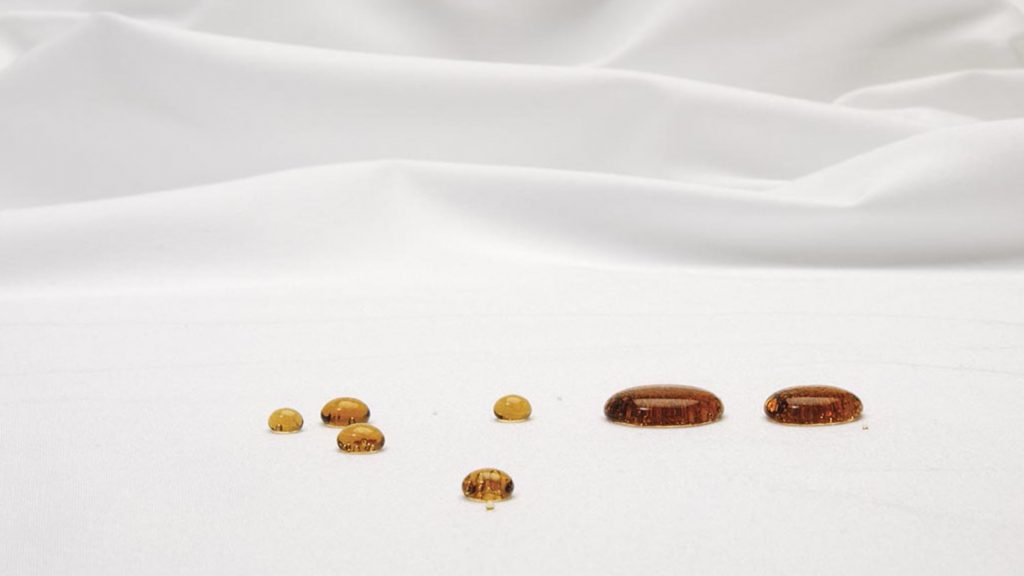
Whether a drop of water beads or soaks in comes down to a tug of war. Water molecules pull strongly on each other (surface tension). If the fabric surface pulls on the water more weakly than the water pulls on itself, the drop stays rounded and rolls away. Scientists describe this with the contact angle, the angle the edge of a droplet makes with the surface.
| Contact angle | What you see | Term |
|---|---|---|
| Below 90° | Drops spread and soak in | Hydrophilic |
| 90° to 150° | Drops bead up | Hydrophobic |
| Above 150° | Near-spherical drops that roll off at a slight tilt | Superhydrophobic |
Two levers raise the contact angle. The first is low surface energy: chemistry that water simply does not stick to. The second is texture at the micro and nano scale: a surface covered in tiny bumps holds pockets of air beneath the drop, so the water touches very little solid material. This is the “lotus effect”, named after the leaf that stays clean in muddy water.
How the fluorine-free options compare
Without fluorine, chemists use other ways to lower surface energy, and lean harder on texture. Independent research comparing commercial water-repellent finishes has found that non-fluorinated finishes can match fluorinated ones for water repellency, while fluorinated finishes keep the advantage against oils (Chalmers University of Technology).
| Finish | How it works | Water | Oils |
|---|---|---|---|
| Fluorinated (PFAS) | Perfluorinated side chains give the lowest surface energy | Excellent | Excellent |
| Silicone | Flexible siloxane chains form a low-energy film | Good | Poor |
| Hydrocarbon or wax | Long carbon chains, similar to paraffin | Good | Poor |
| Nanoscale silica | Particles bond to each fibre, adding nano-texture with a low-energy outer layer | Very good | Moderate |
Nanoman Fabric + Textile belongs to the last group. It is water-based and PFAS-free. Its nanoparticles self-organise around each fibre, binding to the textile on one side and presenting a water-repelling surface on the other. Because the layer is only nanometres thick, the fabric keeps its colour, handle and breathability.
What to expect in practice
A good PFAS-free finish makes water, tea, coffee and similar spills bead on the surface so they can be blotted away before they stain. Greasy and oily stains are more demanding for any fluorine-free chemistry, so deal with them quickly.
Durability depends mostly on abrasion and washing. As a guide for Fabric + Textile:
- Clothing and uniforms: 3 to 6 months, with mild, pH-neutral washing
- Shoes and bags: around 12 months
- Carpets and furniture: 1 to 2 years, depending on traffic
- Awnings, umbrellas and marquees: 2 to 3 years
When water stops beading, clean the fabric and reapply. There is no build-up to strip first.
For mills, finishers and applicators
Most of the cost of a finish lies in moving and storing it. Nanoman Fabric + Textile is supplied as a concentrate and diluted on site, so less volume travels and you mix only what each run needs. Application is by spray: the fabric must be clean, dry and free of softeners, then sprayed until evenly damp, worked in, and left to cure for 24 hours. Our textile protection guide covers each step.
To judge results on your own fabrics, use a recognised method such as the spray test in AATCC 22 or ISO 4920, which grades how much water the fabric holds after a controlled spray. Run it on treated and untreated swatches, before and after a set number of washes, so you can compare like with like.
Frequently asked questions
Is a PFAS-free water repellent as good as a fluorinated one?
For water, a well-applied PFAS-free finish performs very close to a fluorinated one: water beads and rolls off. Fluorinated finishes still have the edge against oils and greasy stains, so the honest answer depends on what the fabric will face.
Does a PFAS-free finish change how fabric looks or feels?
A nanoscale silica finish is invisible. Applied correctly, it does not change the colour, handle or breathability of the fabric.
How long does the finish last?
It depends on wear and washing. As a guide, expect 3 to 6 months on regularly washed clothing, around 12 months on shoes and bags, 1 to 2 years on carpets and furniture, and 2 to 3 years on awnings and umbrellas. Reapply when water stops beading.
How do I know a fabric is still protected?
Sprinkle a few drops of water on it. If they bead and roll off, the finish is working. If they darken the fabric and soak in, it is time to reapply.
Moving your textiles to a PFAS-free finish? Tell us the fabric, the end use and your volumes, and we will recommend a starting dilution.