
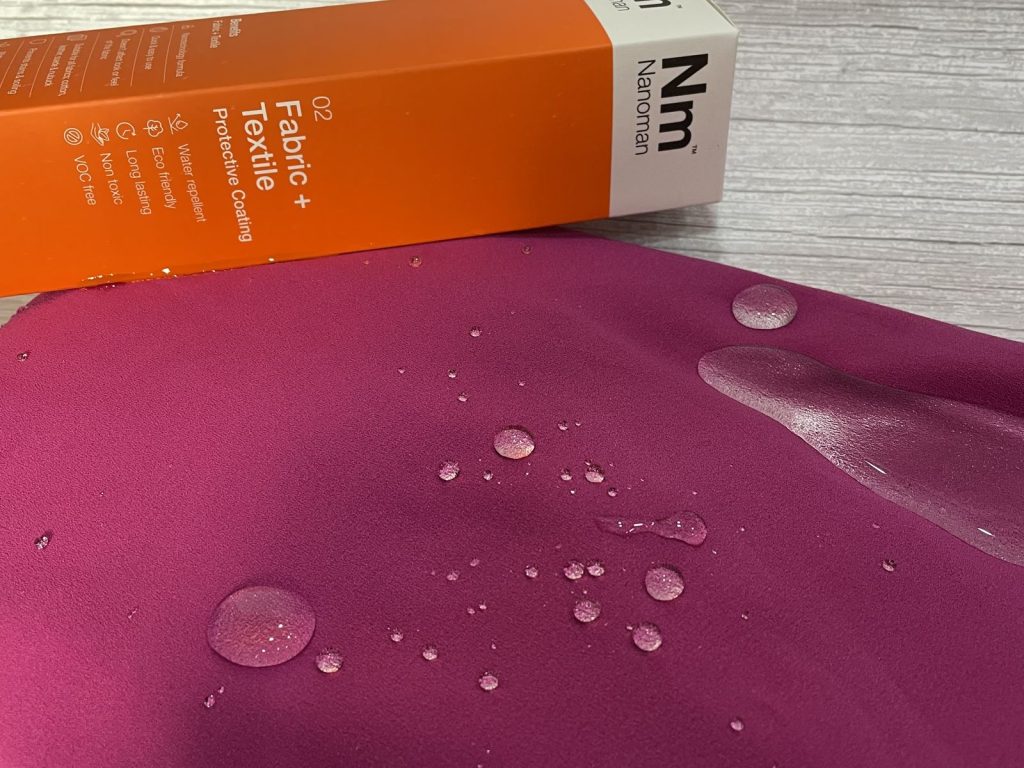
Indian monsoons are hard on clothing. Commuters arrive with soaked trousers, children’s uniforms take days to dry, and a bag that let the rain in ruins what is inside. A hydrophobic coating makes everyday fabrics shed water instead of soaking it up.
This guide explains how a hydrophobic coating works on clothes, which garments benefit most, how to apply it, and how washing affects it.
Key takeaways
- A hydrophobic coating makes rain and spills bead and roll off clothing.
- It is invisible and keeps fabric breathable, unlike a raincoat’s plastic layer.
- It is water-repellent, not waterproof: heavy, sustained rain will eventually get through.
- Washing wears it down; expect 3 to 6 months on regularly washed clothes.
How a hydrophobic coating works on fabric
The coating bonds a nanoscale layer around each fibre with water-repelling groups facing outwards. Raindrops and splashes cannot wet the fibres, so they bead and roll off. Because the spaces between fibres stay open, air and water vapour still pass through and the garment stays comfortable.
Which clothes benefit most
| Item | Why it helps |
|---|---|
| Jackets, overcoats and blazers | Shrug off showers on the way to work |
| School uniforms and bags | Stay drier on rainy commutes; mud splashes rinse off more easily |
| Shoes, canvas and suede | Rain and puddle splashes bead off |
| Trousers and workwear | Hems and knees pick up less water and dirt |
| Travel gear and backpacks | Contents stay drier in sudden rain |
Water-repellent is not waterproof
A treated jacket sheds a shower, but it will not keep you dry through an hour of heavy monsoon rain, and it does not seal seams or zips. For that you still need a waterproof shell. Think of the coating as making everyday clothes cope much better with everyday weather.
How to apply it to clothes
- Wash the garment, then rinse once more in plain water. Detergent and fabric-softener residues block the coating.
- Let it dry completely.
- Dilute the concentrate 1:25 with deionised water (recommended for Indian conditions) and mix well.
- Spray from about 15 cm until the fabric is evenly damp, not soaked.
- Brush it in with a soft brush; wipe leather and suede with a soft cloth.
- Dry with good airflow. Touch dry in 1 to 2 hours; ready to wear after 24 hours.
Washing and care
- Wash cool, at 30 to 40 °C, with a mild, pH-neutral detergent.
- Never use fabric softener; it coats the fibres and stops the finish working.
- Reapply when water stops beading. Reapplying does not harm the fabric.
How long it lasts
| Item | Typical protection | What shortens it |
|---|---|---|
| Carpets and upholstered furniture | 1 to 2 years | Depends on traffic and cleaning |
| Awnings, umbrellas and marquees | 2 to 3 years | Outdoor exposure |
| Shoes and bags | About 12 months | Abrasion and weather |
| Clothing and uniforms | 3 to 6 months | With mild, pH-neutral washing |
Frequently asked questions
Can I wear treated clothes every day?
Yes. Once cured, the coating is invisible and the fabric feels and breathes as before.
Does washing remove the coating?
Washing wears it down gradually. On regularly washed clothes expect 3 to 6 months, then reapply.
Will it make a jacket waterproof?
No. It makes fabric water-repellent, so showers and splashes roll off, but sustained heavy rain and seams will eventually let water in.
Does it work on synthetic and natural fabrics?
Yes: cotton, wool, silk, polyester, nylon, linen and canvas, as well as leather and suede.
Supplying uniforms, workwear or bags? Fabric + Textile is supplied as a 10 litre concentrate for manufacturers and retailers.