
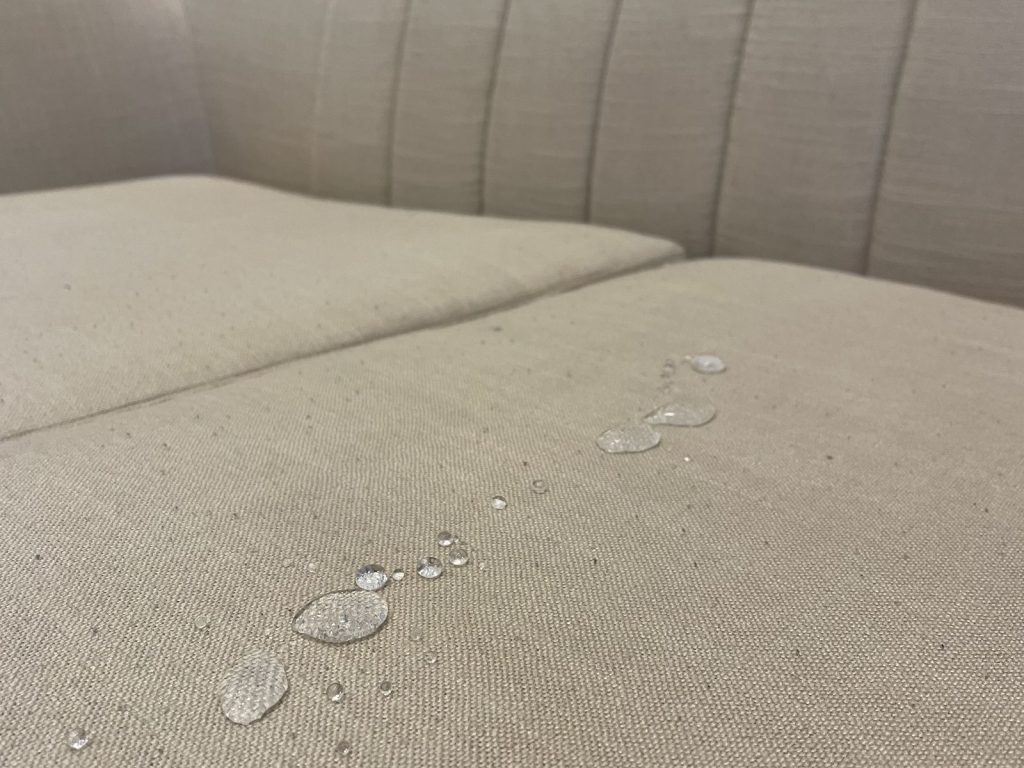
For a furniture brand, a stain on a new sofa is a returned order, a poor review or a warranty claim. For a hotel or restaurant, it is a reupholstery bill. Fabric protection applied during manufacture tackles the problem before the piece ever reaches a room.
Running a sofa care or upholstery business? Our guide to nano coating for sofas has the cost per sofa and a monthly usage calculator.
This guide is for upholstery and furniture makers, contract furnishers and buyers who specify fabric. It covers what a PFAS-free fabric protector does, how it fits into production, and how to judge it on your own fabrics.
Key takeaways
- A fabric protector applied at the factory makes water-based spills bead up instead of staining.
- PFAS-free finishes now meet what many export buyers ask for.
- Spray application fits in as a finishing step; it is touch dry in 1 to 2 hours and cures in 24.
- Test on your own fabrics with a recognised spray-rating method before committing.
Why protect upholstery at the factory
- Fewer complaints and returns: spills that would mark untreated fabric can be blotted off.
- A selling point: “stain-resistant fabric” is a feature buyers understand.
- Consistent results: every piece is treated the same way, before any wear.
- Contract work: hotels, restaurants, offices and transport seating face far more spills than homes.
Why PFAS-free matters now
Fluorinated (PFAS) finishes were long the default for stain resistance. Regulators in Europe and several US states are now restricting PFAS in textiles, and many importers ask suppliers to confirm their finishes are fluorine-free. Nanoman Fabric + Textile is PFAS-free, so treated goods are ready for those requests. Our guide to PFAS-free water repellents explains the regulations and the chemistry.
How it fits into production
| Step | What happens | Typical time |
|---|---|---|
| Prepare | Fabric clean and dry, free of other finishes, softeners or detergent | Before application |
| Dilute | Concentrate mixed 1:25 with deionised water | Minutes |
| Spray | Even, overlapping passes until uniformly damp; HVLP equipment suits production | Per piece or per roll |
| Work in | Soft brush on pile and upholstery | Per piece |
| Dry | Good airflow | Touch dry in 1 to 2 hours |
| Cure | Full performance | 24 hours before packing or testing |
Fabric can be treated on the roll before cutting, or as finished pieces after upholstering. Treating finished pieces covers seams and edges; treating rolls is faster per square metre. Coverage is about 60 to 80 ml of diluted product per square metre on typical upholstery fabric.
The economics of a concentrate
Fabric + Textile is supplied in 10 litre concentrate cans. Diluted 1:25, one 10 L can makes 260 litres ready to use. You ship and store a fraction of the volume and mix only what each run needs.
How to judge it on your fabrics
Run a spray test such as AATCC 22 or ISO 4920 on treated and untreated swatches of each fabric you use. Repeat after a set number of cleaning cycles to compare durability. For upholstery, also test with the spills your customers actually face: tea, coffee, juice and water.
Limits worth knowing
- It is water-repellent, not waterproof, and does not seal seams.
- Oil and grease are not fully repelled by any fluorine-free finish.
- Fabrics already carrying another protector should be tested first.
How long it lasts
| Item | Typical protection | What shortens it |
|---|---|---|
| Carpets and upholstered furniture | 1 to 2 years | Depends on traffic and cleaning |
| Awnings, umbrellas and marquees | 2 to 3 years | Outdoor exposure |
| Shoes and bags | About 12 months | Abrasion and weather |
| Clothing and uniforms | 3 to 6 months | With mild, pH-neutral washing |
Frequently asked questions
Does a fabric protector change the hand or colour of upholstery fabric?
No. It bonds around individual fibres and leaves no film, so colour, hand-feel and breathability stay the same. Test each fabric to confirm.
Can we treat fabric before cutting and sewing?
Yes. Rolls can be treated before cutting, or finished pieces after upholstering. Allow 24 hours for full performance before packing.
Is it suitable for export orders?
It is PFAS-free, which meets a common request from EU and US buyers. Check each buyer’s own specification.
What equipment do we need?
Standard HVLP spray equipment works for production. We help you set up application on your line.
Adding stain protection to your upholstery? Tell us your fabrics, products and monthly volumes and we will help you set up a trial.