
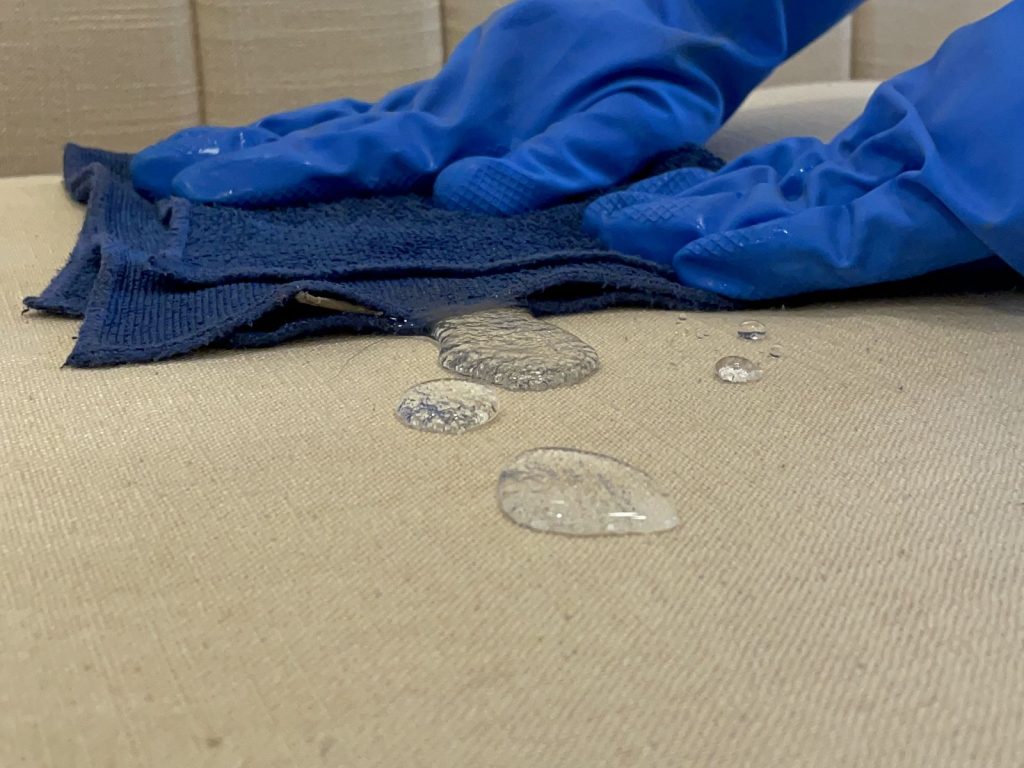
A sofa takes more punishment than almost anything else in a home: tea and coffee, children’s juice, a monsoon of damp clothes, sweat on warm afternoons and a steady settling of city dust. Most of that damage starts the same way. A liquid soaks into the fibres before anyone can reach for a cloth.
For costs, how long it lasts and how to get your own sofa done, see our full guide to nano coating for sofas.
A nanocoating changes that first moment. This guide explains how a hydrophobic coating protects sofa fabric, what it can and cannot stop, how to apply it, and how long it lasts in an Indian home.
Key takeaways
- A nanocoating makes water-based spills bead on the fabric long enough to be blotted away.
- It is invisible and breathable: colour, softness and comfort stay the same.
- It does not fully repel oil and grease, so oily spills still need fast blotting.
- Expect 1 to 2 years on a sofa, depending on use and cleaning; reapply when water stops beading.
How a nanocoating protects sofa fabric
Nanoman Fabric + Textile carries silica-based nanoparticles that bond around each individual fibre and leave water-repelling groups facing outwards. Water cannot wet the fibres, so it pulls into droplets that sit on top of the weave. The gaps between fibres stay open, which is why the fabric still breathes and feels the same.
The coating is a finish on the fibres, not a film over the fabric. That is the difference between a nanocoating and a plastic or vinyl cover: nothing changes how the sofa looks, sounds or feels to sit on.
What it handles well, and what it does not
| Everyday problem | Effect of the coating |
|---|---|
| Tea, coffee and juice spills | Liquid beads on the surface; blot it up with a paper towel |
| Water and damp clothes | Beads off instead of soaking into the cushion |
| Dust and dry dirt | Sits on the surface and vacuums or brushes away more easily |
| Sweat and body oils | Reduced, but oils are not fully repelled; clean regularly |
| Oil, ghee and greasy food | Not fully repelled by any fluorine-free finish; blot at once |
| Pet accidents and heavy soaking | Buys time to clean up; not a waterproof barrier |
Indian homes: humidity, monsoon and dust
In humid months fabric stays damp for longer, and a cushion that has soaked up a spill can smell musty before it dries. A treated sofa keeps most water on the surface, so less moisture reaches the foam underneath. In dusty cities and in spring, when windows stay open, dust lands on the fabric rather than working into it, so regular vacuuming removes more of it.
How to apply it to a sofa
- Vacuum or brush the sofa thoroughly to remove dust and loose fibres. The fabric must be clean and completely dry.
- Test on a hidden area first, such as the back or underside of a cushion.
- Dilute the concentrate 1:25 with deionised water (recommended for Indian conditions) and mix well.
- Spray from about 15 cm in even, overlapping passes until the fabric is uniformly damp, not soaked.
- Work it in with a soft brush so every fibre is covered.
- Let it dry with good airflow. It is touch dry in 1 to 2 hours and ready to use after 24 hours.
- Check: sprinkle a few drops of water. They should bead. Re-treat any patch that darkens.
Coverage is about 60 to 80 ml of diluted product per square metre on typical upholstery, and up to 100 ml on very absorbent fabrics.
Caring for a treated sofa
- Blot spills straight away with a paper towel. Do not scrub, which pushes liquid into the fibres.
- Vacuum regularly; dry dirt lifts away more easily from treated fabric.
- Use water or a mild, pH-neutral cleaner for marks. Avoid harsh detergents and solvents.
- Reapply when water stops beading. There is nothing to strip first.
How long it lasts
| Item | Typical protection | What shortens it |
|---|---|---|
| Carpets and upholstered furniture | 1 to 2 years | Depends on traffic and cleaning |
| Awnings, umbrellas and marquees | 2 to 3 years | Outdoor exposure |
| Shoes and bags | About 12 months | Abrasion and weather |
| Clothing and uniforms | 3 to 6 months | With mild, pH-neutral washing |
These are guide figures for average use. Heavy daily use, frequent cleaning and abrasion shorten them.
Frequently asked questions
Will a nanocoating change how my sofa looks or feels?
No. It is invisible and bonds around individual fibres instead of forming a film, so colour, softness and breathability stay the same.
Does it work on leather and velvet?
It works on fabric, leather and suede. On leather, wipe it in with a soft cloth instead of brushing. Velvet and other pile fabrics should be brushed in the direction of the pile. Always test a hidden area first.
Will it stop oil and curry stains?
Not completely. No fluorine-free finish fully repels oil and grease. The coating slows them down, but oily spills should be blotted at once.
Can a sofa manufacturer apply it before delivery?
Yes. It is spray-applied and can be added as a finishing step on the production line. See our textile protection guide for manufacturers.
Protecting sofas at scale? Furniture and upholstery makers can add Fabric + Textile as a finishing step. Tell us your fabrics and volumes.